Showing posts sorted by relevance for query RIP Sprocket. Sort by date Show all posts

Saturday, August 28, 2010

RIP, SPROCKET


Not long after being diagnosed with a cancerous tumor in his right jaw, Sprocket died at home with us on Saturday, August 21st surrounded by his siblings. He was 16 years old. I've been blessed with raising several kitties in my lifetime (Tuna Breath, Cocaine, Crash, Katie, Jumpy, Scout), but Sprocket was that "long-time companion" that I had a special bond with.

Life As A Kitten
Back in June of 1994, I had been taking care of my friend Jay Schwed's 19-year-0ld kitty, Gooby. She was a sweet-natured kitty but not particularly friendly to me. My kitty Crash was only 7 when he died ten months before and taking care of Gooby made me realize I was finally ready to adopt another companion. I put the word out to my friends that I was looking again. Crash was a black and gray striped short hair tabby and I thought this time that I would get an orange tabby. My friends were telling me about people they knew who had new kittens and I did look at lots of kitties. However, I wasn't having much luck finding a companion that seemed like we would be a good fit.

I remember it was a Wednesday, middle of June and I was driving down Ventura Boulevard in Studio City. I drove past the PETCO near Coldwater Canyon and something told me to turn around and go back. It was just this strong sense, a feeling that I had to go into this store. Sure enough, there were kitten adoptions sponsored by an organization called "Lifeline For Pets."

It was in the late afternoon, and almost all of the kittens were napping but there was this one black and white kitten that caught my eye. Even though all the other kitties were asleep, he still had lots of energy and wanted to play with my long ponytail I put up to the cage. He was a wild, 12 weeks old rescue kitten. I got permission to hold him and he had this wonderful deep purr. It didn't take me long to decide that this little boy was the one. I wanted to take him home right then but the ladies managing the kittens said I couldn't take him home; that my adoption had to be approved by the foster parent who wasn't there that day. Besides, they indicated that they had to check out my home to ensure it was kitty friendly and had screens on the windows.

I was beside myself. I couldn't believe it that they wouldn't let me take him home. They said it would have to wait until Saturday, when they would deliver him to my home and give him his last set of shots. I couldn't wait until Saturday! When my new companion arrived on June 16th, he made himself right at home.


One of the endearing things Sprocket did that first night and continued until he was about 10 years old was sleep on my right shoulder. Before he would go to sleep he would do the paw-paw into my neck, suckle on my right ear lobe and purr. As he got older he didn't sleep with me as much but he still occasionally sucked on my ear until he was about 12 or 13.

I had quite a few plants in that second floor apartment including seven ceiling height trees and it didn't take long for my new kitty to discover them. That's when I realized that he had more wild energy than my large house plants could take. His favorite game was sitting on the edge of the Terra cotta pots, leaping as high as he could, grabbing on then trying to climb to the top of the stalk before he got hit with the spray bottle. Even shaking 20 pennies in a can like the animal guru Warren Eckstein recommended didn't phase him or deter him from running around the apartment like a maniac. In time, he eventually pulled every single one of the trees out of their pots from climbing them and hanging on until he jumped down.

Once he had settled in, it was time to come up with a good name. My last kitty Crash had a motorcycle related name, (his full name was Redline Crasher; Crash for short) and I wanted to give my new companion a motorcycle related name, too. Several ideas I though of were Suzuki ~since I rode a GS750E~, Katana, Basanni, Webber but those didn't seem to fit. I settled on "Rear Sprocket" which eventually became just Sprocket.


When Sprocket was five months old, he taught me how to play fetch. I was on the sofa trying to get some paperwork done and he kept pestering me, getting into my papers and pushing them all around. I threw one of his tiny mouse toys across the room to try to get him to go play with the mouse. He ran after it, picked it up, brought it back and dropped it right in front of me. Surprised, I threw it again and he did the exact same thing. I threw it again. Repeat. Twenty, thirty times in a row, he brought it back. Fetch became one of the games he loved to play. He brought it back every time until he was 2 1/2 when he decided he only needed to bring it back halfway before he would drop the mouse.


Along with his climbing the house trees, he started to climb other things in the house. Here he is at about six or seven months, hanging out on the front door.


And, he liked to get into things. Trash cans became places where he would find new toys.
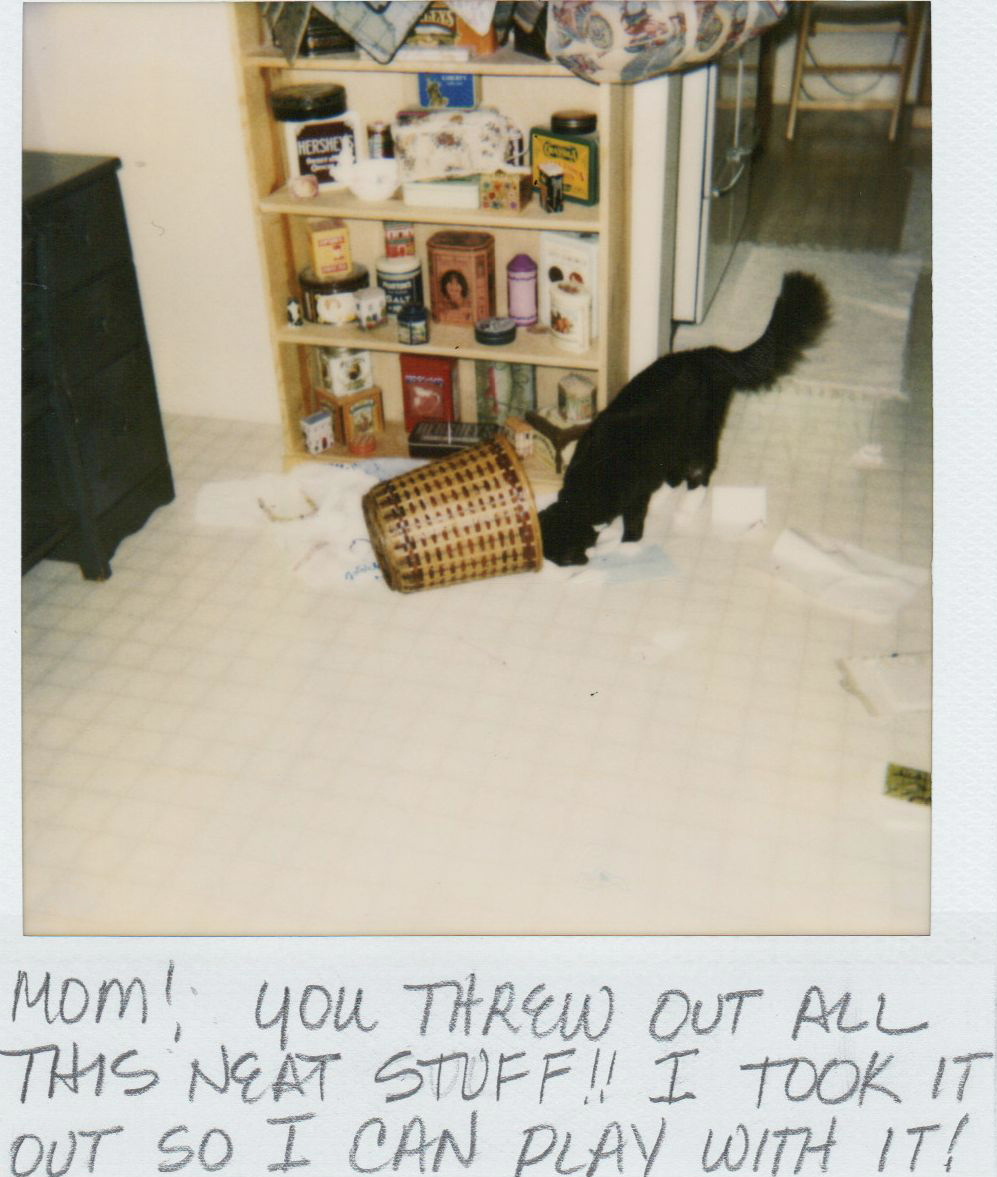

And, he liked to hide behind things like kitties do.

Sprocket, like many kitties became a bag and box lover. Leave a bag or box out and he had to make it his property for a while.


He'd let me know when his water bowl was low

... and when he was hungry.

Another difficult task was trying to box up presents around Christmas.

A little after he was two years old, a longtime girlfriend from Ohio came to visit with her 10-year-old black and white female doggie. Sprocket had never been around a dog before, but fortunately for Sprocket this doggie was raised around kitties. After they got to know each other... (that's my friend in the photo)


... Sprocket tries to get her to play with him.


Here's another attempt to get a playmate.


Sprocket got into just about anything and everything. He had a never ending curiosity. I remember one time in the old apartment, I was in the living room and I was hearing this THUMP! THUMP! THUMP! coming from the laundry room. I go to the laundry room and the noise is in the dryer. I open up the dryer and Sprocket jumped out. Fortunately, there had been a full load of clothes in the dryer almost dry when he crawled in. If I left the washer lid open, he would jump in. I finally cured him of that by holding down the lid lever when he got in there one day and turned the washer on to fill it. That cured him; he never got in the washer again.

As a kitten, he loved to watch me take a bath. He was fascinated by splashing water and loved to watch it but hated with a passion having to endure the torture of a bath for himself. When he was older, it took two people to bathe him.

Another big adventure when he was two-and-a-half was the great escape. I had a long work day and when I came home, Sprocket had vanished from the apartment. I couldn't find him anywhere. Then I looked in the laundry room and saw that the window in the back door was left up and a huge hole had been torn in the screen. He had gotten up on top of the dryer, smelled that fresh air coming in through the window screen and clawed his way out.

I was beside myself frantic. I printed up hundreds of flyers and enlisted my neighbors to help me look for him. I crawled under houses searching for him. He was gone for two days. On the third day, I got up real early so I could put some food out on the back stairs thinking that might entice him home. When I opened the back door, there he was, climbing the wood steps. He was black all over, had a few ripped nails and had picked up fleas. But other than that, thankfully no injuries. He got his first and only trip to a groomer to get him white and black and fluffy again. That big adventure started a life long battle with him and his desire to go outside. He escaped many times after that but fortunately never got very far or was AWOL for more than an hour.

Moving To A New House
When he was three I moved into this current house and Sprocket's daily world got quite a bit bigger. There were new things to climb, like the shower door.


And he liked to help out with my sewing projects

and try out the fabric boxes.


There were new hampers to get into

new towels to get under
new places to nap


and new clients with shoes to check out.


A New Parent
In 2001 my husband came into my life and Sprocket made an easy transition to having two parents instead of one. My husband had never lived with a kitty before and it took him a little while to adjust. For Sprocket, there were now more boxes (from my husband's work) to get into


bigger shoe boxes to claim


some humiliating situations to tolerate


as well as antlers at Christmas.


My husband also thought that Sprocket really wanted to go outside and hooked up an elaborate overhead fishing line to attach his leash to that ran from the patio all the way to the back property fence. With his leash attached to the line, he had about six to eight feet wide and approximately fifty feet long to hang out in. Every day he made a loud fuss at the back door until we took him outside. He could chase the squirrels a short distance and watch the birds.

We even included him in our backyard wedding.

He was to be the ring bearer and walk toward us on his fancy tether.


But when he didn't walk toward us like planned, my husband had to retrieve our rings off of his collar.


Sprocket loved being outside. However, he became Mr. Hyde when it came time to come back in. It got to the point where I had to throw a towel over him pick him up. When he became almost like Houdini and found a way to wriggle out of his harness his days of being outside had to end.

My husband often let him get up on the desk to take a nap when he was working on the computer.


Getting Siblings
When Sprocket turned 10 in 2004 we decided to get him some siblings. My husband didn't know anything about how much fun kittens could be until eight-weeks old Jumpy and Katie arrived.


Sprocket wasn't really happy about it, but he tolerated them. Up until then, he got all the attention.


He would watch them play...


and maybe look out the front door with them...


...but that was about it. As the kids got a bit older, Sprocket tolerated Katie and would occasionally let her get near him. Here's a rare photo of them together on the massage table.


And rarer still, all three kitties on the bed. But as you can see, Sprocket kept a safe distance.


After a rainstorm one cold February day in 2006, a stray kitty showed up on our back patio. He was crouching on top of an old cat condo that Katie and Jumpy had destroyed when they were kittens. We slowly gained his trust by fixing up a comfy warm bed inside a box elevated off the ground and regular, tasty meals.


The inside kitties watched him from the bedroom patio doors.


My husband eventually convinced me to let Scout come inside and meet the other kitties. We knew that Scout had been abandoned because he was already fixed but we didn't know how he would get along with the rest of the fur kids. The first time we brought him inside, he gave an affectionate head tap to Sprocket and then Katie. Sprocket had a fit and hissed at him. He was our inside and outside kitty until a serious bite by another cat (or dog; we never knew) ended his outdoor life. Eventually, Sprocket got used to Scout and on rare occasions would share a drink at the water bowl with him.


Scout and Sprocket had a few big adventures together. You can read about how Sprocket left his paw prints in the floor when we had to completely rebuild our kitchen floor last summer. Scout also figured out how to open the latch on the upstairs window that opens over the first floor of the roof. Sprocket followed him out but we were never sure how they both got down off the roof.

In the late summer of 2009, Sprocket started to have a ravenous appetite and at the same time, he was losing weight. For most of his life he was a hearty 16 pounds but he was down to just under 13 pounds. I had a hunch what was going on and I took him to get a full blood panel to get it confirmed. His thyroid numbers were off the charts. He had feline hyperthyroid. This would eventually kill him if he did not get on a special diet and medication for the rest of his life. But I was also reading about a treatment that could completely cure him: radioactive iodine. I found Advanced Veterinary Medical Imaging in Tustin, CA. After some finagling, I got Sprocket accepted as a patient. You can read about his week-long stay in the clinic here.

Although Sprocket recovered completely from that illness, he never regained the four pounds he lost.

In January this year, Sprocket was sleeping a lot and not eating as much. He had a follow-up blood test that indicated his kidneys were not doing too well. I took him to his long-time acupuncturist who gave him a needle treatment. Sprocket slowly started to get better and to speed up his recovery, I started to take him for walks outside. That became our ritual for the next month. He would get to go for a walk in the afternoon. He loved to go in my neighbor's backyard and chew on the tall wild grass. After a few weeks, Sprocket started to improve and get his appetite back.

The Long Goodbye
In June, he started to decline again and I took him to a new vet for an exam and tests. The blood tests indicated his kidneys were back to normal but his liver enzymes were off the charts. The new vet thought he had a "non-active" tumor in his right ear. When Sprocket started to have balance problems getting up and down off the big cat tree, we knew we needed a second opinion. Enter the wonderful Dr. Sandy, who makes house calls.

Here's Sprocket the morning Dr. Sandy came to see him.


Dr. Sandy reviewed all of Sprocket's prior medical records and gave him a complete examination. She had me feel along both sides of his jaw at the same time to show me what she had discovered. There was a noticeable mass on his right jaw. She recommended we immediately put him on a high nutrient diet (Royal Canin Recovery RS) and that we take Sprocket to see Dr. Mills at the City of Angels in Culver City for an ultrasound of his jaw and liver. The people at this hospital were just the best and I will forever be indebted to Dr. Mills for his compassion and kindness that he showed Sprocket.

Dr. Mills did an extensive ultrasound of his liver and jaw and also drew aspirates (a needle is inserted and material is drawn out) from both areas. In his jaw he saw a mass that extended around to his cerebellum, the area of the brain just above the brain stem. (It wasn't inside his ear.) Dr. Mills said that the attachment of the mass on his brain was what was causing his balance problems and his inability to control and close his right eye. Unfortunately, the pathology on the aspirates was inconclusive. It didn't tell us anything. The procedure of drawing the aspirates was a big strain on Sprocket's body and it took days for him to recover. I had to decide whether or not it was reasonable to put him through the trauma of a biopsy procedure with anesthesia to confirm what we suspected: that Sprocket had cancer. Without getting a confirmation, Dr. Mills thought with the inconclusive results, it was most likely Sprocket had one of the more aggressive cancers, either a sarcoma or carcinoma that don't give up their cells easily.

On July 8th, with tears in my eyes all the way home, that was the beginning of the long good-bye. The goal was to keep him comfortable and the best quality of life possible. It was hospice care from here on. Sprocket was on the special diet, an appetite stimulant and fluids under his skin once a day and later, twice a day. Unfortunately, we had to take his favorite big cat tree out of the living room because he had already fallen off of it once, and he could seriously hurt himself if he fell again.

To keep his spirits up, I started taking him for a walk in the mornings and sometimes in the afternoon. After he ate his breakfast he would sit by the back door and wait until I got his harness and leash out. For the first few weeks, he liked to go next door to our west side neighbor, where he liked to munch on some tall wild grass in her back yard and hit his favorite spots in the flower garden. Eventually, Sprocket settled into a routine where he stopped at the back patio, stretched and then walked the driveway to the front of the house. He would stop at the big log, beside the hedge and look into our neighbor's yard towards the east. Then he'd head over towards the front walk. If the sun was out, he would stop at the Chinese coin stepping stone and lie down in the grass. After he was nice and warm, he would walk up the front porch steps and get up on the cat condo. I would sit there with him until he got sleepy and then I would bring him inside.

As the tumor grew and spread up behind his right eye, his ability of open his jaw became less and less. I had to puree his special diet food to a pudding consistency so he could eat. Each day, he still wanted to go for his walk outside. He was able to get around pretty well, get to the water bowl and hit the litter box without any assistance.

In those last weeks, he spent a lot of time in one of his favorite spots, the back of the sofa. One day, Scout wouldn't move when Sprocket wanted to lie down and I got a rare photo of them sharing the sofa.


Often times, I would bring his food bowl there so he didn't have to get down. Here is a short video of him having a meal.


The time finally came when Sprocket was no longer able to open his jaw wide enough to get his tongue out of his mouth to eat. It was time to end his suffering and say goodbye. The day before, Sprocket had two nice walks outside. Saturday, he spent all day on the back of the sofa, purring away. He was a fighter until the very end.

The month before, I had found this beautiful black and white hinged box in a second hand store. It was cardboard covered with a soft black leather. Inside was a nice black and white paper lining. I made him a black and white kitty mat bed for the bottom and a black and white blanket to cover him with. Lewis suggested we put his favorite brush in with him that he liked to have his chin scratched with. We dug his grave before the doctor arrived and afterwords we buried him in the back yard next to Katie. As soon as we can, we will engrave a large river rock with his name.

I hope you enjoyed reading Sprocket's story. He was a wonderful companion with whom I had a close, special bond. We will never forget him for his memory and funny antics will always reside in our hearts.

Sprocket on a pile of blankets, ready to be sewn.

Thursday, February 10, 2011

Dr. Conrad Murray's Death Drip: Explained - - Part 4

© Trials & Tribulations 2007-2011. All rights reserved, do not reproduce in whole or in part without the express written consent of Trials & Tribulations.

This is a GUEST ENTRY by KZ. KZ, a CRNA, is giving T&T readers her analysis of the events that apparently caused Michael Jackson's death, based on the evidence presented at the preliminary hearing. Sprocket

Conrad Murray's Death Drip: Explained
Part 1 - IV Technique: Tutorial on the Basics
Part 2- The Evidence: What we think we know from preliminary hearing testimony
Part 3 - The Lies: Conrad Murray's words and actions
Part 4 - Putting it all together: What I think really happened

Introduction/ Disclaimer:
My report of the evidence in this article, and my conclusions are the result of my own critical thinking and speculation. I did not sit in the courtroom listening to testimony, nor have I seen any actual evidence or photographs of evidence in this case, and I don't know a single person connected to this case. So, as a disclaimer, think of this article as a couple of us private citizens gathering at Sprocket's home for some great conversation, coffee, and dessert. (And I hear Sprocket is a generous and gracious host! All photos are mock-ups I created and are NOT evidence photos.)

Part 4 - Putting it all together: What I think really happened

Is THIS the Propofol Death Drip technique Conrad Murray used that killed Michael Jackson??

(Disclaimer: this is a photo mock up, and was cobbled together with medical items from the trash, just as Conrad Murray possibly did. This is NOT an evidence photo.)

Yup. I think this is it. And I'd bet a good cuppa fancy coffee (Hazelnut Latte, tall, please, with cinnamon) that I'm correct.

You see, I wrapped my brain around the "bottle in a bag" for days. My colleagues and I puzzled it out. The only thing we could initially come up with was that he was collecting his empties in an IV bag, which some anesthesia providers have been known to do in a crisis, to keep track of what was given. Or that he used the outer wrap of the IV bag to collect his empties. Maybe so he could carry them out of the mansion for disposal. Something like this:


Trash (empty bottle) in the outer wrapper of an IV bag

But then, I remembered that there were full, partially used, and used vials ALL over the room, from the testimony. The place was a pigsty of medical equipment. So, why would Conrad Murray (CM) suddenly become all neat and tidy, who had an obvious pattern of being messy and disorganized with medical equipment?


I even BRIEFLY entertained the horrifying thought that maybe CM was removing the neck bands and stoppers of the 100cc propofol vials and POURING the propofol into a slit open used NS bag to drip it. That would account for the liquid in the bottom of the NS bag, but why put the bottle inside? That gave me nightmares and cold sweats for days. Dear God, even CM couldn't be THAT stupid and reckless, could he?

Then I read a comment that the bottle was "attached" to something at the bottom of the inside of the IV bag.

I also remembered that the "bottle in a bag" was the FIRST thing CM turned his attention to removing/ hiding. (Never mind that annoying airway management thingy, or the CPR thingy, or the 911 thingy.) Why hide a bag being used for empty bottles? And why the sudden urge to tidy the place up, directing Alvarez to hold open a bag to accept a bunch of med bottles? Is that REALLY his first priority when his one and only patient is in a full cardiac arrest? And whew, I'm ever so glad CMs extensive medical education and Cardiology board certification helped him to diagnose the medical condition of full cardiac and respiratory arrest, and without any fancy machines or labs, even! He is one sharp doctor! If only an Intra Aortic Balloon Pump had been available right then and there, I'm sure CM would have known just what to do. But I digress.

So, the conclusion I came to reluctantly, and astoundingly, was that CM was indeed "free dripping" propofol. Without ANY electronic infusion pumps or volume control devices. And very likely using maxi drip IV tubing. And he piggybacked the whole "arts and crafts" project into the Y site nearest MJ's left leg (saphenous vein, below the knee) insertion site, which is why the Y-site had propofol (and lidocaine, from his syringe doses) in it, and the tubing upstream to the NS IV bag, did not. That there was LIDOCAINE in the Y site lends support to the possibility that it was not a drip ALONE that produced the respiratory arrest. He may, indeed, have bolused him from a syringe, on top of the drip, if he was not adding lidocaine to the 100cc vials. OR he could have been injecting some lidocaine into each bottle before spiking it.

Once I recovered from my own nausea while imagining the ramifications of that horrifying free drip/ maxi drip tubing "technique", I was determined to figure out how and WHY he was dripping propofol this way. (When there were SO MANY easier, less hazardous methods.....like a cheap IV pump, or a buretrol.) I was determined to figure out the "bottle in a bag" that was SO important for him to get rid of quickly-- before paramedics were called. Because there is absolutely no evidence that adds up that CM was NOT dripping the 100cc bottles of propofol, except HIS own words. And he is a liar.

KZ has a serious question about the evidence. Did anyone ever count how many punctures were in the rubber stoppers of any of the used vials? This would be VERY interesting to know. Especially for the 100cc vials. And were the punctures small, from needles, or a larger puncture, from the spike of IV tubing? There were a number of used and partially used vials at the scene. Gosh, I hope LE evidence techs counted the punctures! You see, that is HUGELY relevant to the technique CM was using. If he were puncturing the 100cc vials with 10cc syringes, which we know he had from the coroner's office report, he would have had to puncture each 100cc vial 10+ times to suck out 100cc of propofol. (Must allow a few cc per syringe for the lidocaine CM used, as well as vial overfill of up to 10cc, which usually accounts for tubing fill. 100cc vials are designed for dripping in ICU's and have a small band attached to the bottom for hanging. However, it is possible to open a 100cc vial and use smaller doses by withdrawing using a needle and syringe.)


Hanging band for IV pole (Generic propofol)


As I pondered the issues of free dripping propofol without an infusion pump, I was struck that he very likely only had one brand or style of IV tubing, the same tubing he was using for the Normal Saline mainline. And clearly Murray had 100cc propofol bottles-- a LOT of them. And remember, he clearly had a choice of what size vials to order, because he ordered 20cc and 100cc vials specifically in each order, in full carton amounts. He didn't get the bigger size, for instance, because the smaller vials weren't available or back ordered. Now, unless the 100cc empties at the scene had LOTS of needle punctures in the stoppers, there is only one way to get the propofol OUT of the bottle without making a sieve out of the stopper. I'm betting the empties had only ONE puncture, from the large spike of a set of maxi drip IV tubing.

To be fair, there IS another way to fill syringes using IV tubing. The bottle is spiked with tubing, and a 3-way stopcock is attached to the tubing. A syringe is hooked to the stopcock, the little lever is turned, and a syringe can be filled rapidly. We practice this technique with a medication for a very rare anesthetic complication called Malignant Hyperthermia. The medication, Dantrolene, is mixed up and rapidly drawn up this way. We practice this drill and teach RN's in the OR and PACU how to do this in the event of an emergency. But I think there is NO chance this is what CM was doing, and no one has reported anything that looks like a 3 way stopcock at the scene. And if CM was doing this, for sure he would have explained this by now, as a means to explain how he did NOT have a drip hanging every night.

But let's get back to propofol IV drip technique. Dripping something from a sealed glass bottle is not exactly easy. It's not as simple as spiking the bottle onto tubing, twirling open the pretty blue roller clamp, and letting it run in. In fact, to even "prime" (fill) the IV tubing with a thick liquid like propofol, you have to remove the cap from the end of the empty, new tubing to get the liquid to fill the tubing, keeping the end sterile and letting it run over a trash can. Refer back to Part 1 of this series, IV technique: A Tutorial.

To get something out of a sealed vial, you must put air inside to create positive pressure to allow you to suck the meds out, or gravity drip them out, in this case. Otherwise, a vacuum is created after only a small amount of liquid is removed. I'm going to show my age here, but imagine pouring ketchup out of a new glass bottle (the old fashioned kind, not the new plastic ones. Remember the Carly Simon "Anticipation" commercial?) If you turn the ketchup bottle completely upside down, to encourage faster flow, the thick ketchup plugs the neck and doesn't allow air inside. You had to vent the ketchup bottle with a knife or something to get the ketchup to flow, once the neck was occluded. The more skilled ketchup pourers were able to keep an air vent open by tilting the bottle carefully. (Anticipaaaattion is makin' me wait.....)

So how DO you vent a sealed glass bottle and IV tubing? Well, if you have access to it, you properly use VENTED tubing. It comes both in "simple" non- pump tubing, as well as specialized tubing for a specific brand of electronic pump. (And well, we KNOW there were no infusion pumps in that bedroom.)


The blue tab is the vent port of Mini-drip tubing left open.


This picture shows a vented mini-drip tubing drip chamber. The little blue "door" is the vent.


But in a pinch, if you don't have vented tubing, you can vent the bottle with a sterile needle and syringe. However, you have to re-vent the bottle again and again to keep the med flowing. And sometimes the stopper starts to leak from all the needle punctures. So, I have seen providers in a crisis situation take the syringe off the needle to let air in. And, of course, the needle hub leaks whatever is in the bottle. Plastic IV bags don't have this problem, and don't require vented tubing to flow. The plastic is flexible enough that it conforms to the remaining volume in the bag, and no vacuum is created by the flow.

Now, I like a good arts and crafts project as much as the next person. And Murray's technique is CREATIVE, I must say. Unbelievably stupid, completely nonstandard, and breathtakingly (no pun intended) reckless, too. But undeniably creative. (But sorry, CM, no bonus points for creativity when your patient is DEAD.) So let's look at it again: (And yes, I'm pretty well convinced this is what he was doing. We won't know if I'm right or wrong until the evidence photos are shown at trial, if the trial is televised.)


Bottle spiked inside bag.


In the bottom left of the image inside the saline bag, you can just barely see the needle vent placed in bottle.


Doctor, did you find that technique in a book or online somewhere, perhaps in a professional journal? Gosh, I can't find something like that anywhere, but I'm just a lowly advanced practice Nurse Anesthetist! Because it is pure science fiction or fantasy to suggest or imply that your "technique" is either SAFE or APPROPRIATE in any way. (And we have witnesses to the evidence photos that you did something JUST like this, in the care of your patient, MJ.)

You see, Conrad Murray had several little nagging problems to solve. And since he was being paid something to the tune of $150,000 A MONTH, (golly, that's $5,000/ a day, or $208 an HOUR!) well, perhaps he was encouraged to set aside just a few moments in between intimate romps, cell phone calls, texts with his girlfriends, and escalating pharmacy orders, to think about how to keep his one and only patient ALIVE. (....Nah...that didn't happen, obviously.)

You see, this technique unquestionably solves Murray's problems, but does very little to solve the problems of his PATIENT. (Like breathing-- that's sort of a big problem when you AREN'T.)

Okay, so I'll explain. (Pour a cup of your favorite beverage, hit the bathroom, then come back and settle in for a few minutes.)

The basics: If you stop breathing properly, then your heart stops beating properly, then you die. (I learned that even before my baccalaureate nursing program, BTW, Dr. Murray.)

So, that "if you stop breathing properly" thingy is sort of important. We can agree on that, right Doctor Murray?

A bunch of stuff can cause a person to stop breathing. Like massive trauma, head injuries, terminal cancer, paralyzing drugs (think execution by lethal injection), too many narcotics, bullet wounds, electrocution, manual suffocation, strangulation, distraction due to text messaging, cell phone calls, etc. None of these things took away MJ's breath. Oops, my mistake-- maybe the text messaging and cell phone calls had some influence on the "not breathing."

MJ was lying in a bed in an expensive rented mansion, with a house full of high priced staff, and a very high priced personal Cardiologist, who was supposed to be somewhere "sort of close by", right? MJ was 100% vulnerable at the point that Murray rendered him unconscious, and MJ could not advocate for himself. Once anesthetized by CM, MJ was the very definition of a "vulnerable adult." At that point, MJ had paid CM to advocate FOR him. And CM was a bit distracted. But MJ wasn't anesthetized, was he? Dr. Murray said he wasn't.

The combination of benzodiazepines and propofol took away MJ's breath, and roundabout 5 to 15 minutes after that, MJ's heart protested in vain for a while, and then he died. MJ had a healthy heart, so it attempted to kick out some random electrical "help me" pings for a period of time after it quit beating with organized purpose, but the window for resuscitation had passed. While his DOCTOR was on the phone with a girlfriend. And definitely NOT paying attention to his patient, who had stopped breathing due to the reckless cocktail of intravenous (and possibly oral, as well) medications MURRAY provided to his "patient."

Okay, I'll stop ranting and explain. Permit me to explain further by exercising some of my own creativity. I like creative writing, so I'll explain by telling a bedtime story of "Doctor and Patient, and Thumb."

Patient had been receiving daily intravenous benzodiazepines and IV propofol for significant amount of time. At least 8 weeks that we know of, and likely longer than that. Whether you believe or not that he was an "addict" (an emotionally laden word for his many fans, and I will address this at the end), his body was experiencing "tachyphylaxis." I believe MJ was chemically dependent, and had been for a very, very long time.

Cytochrome P450


Tachyphylaxis means that the small doses that CM may have started out giving to MJ weeks earlier, did not have the same psychological and physical effect anymore. Repeated exposure to (escalating doses of) propofol caused his body to become very efficient at metabolizing the substance/s. Plus the benzodiazepines--and what is a liver to do? Liver gets efficient! Go liver! Ramp up that CP450 enzyme system! Except that tachyphylaxis can be cruel-- it suppresses the "fun" aspects of some drugs (like euphoria and well-being), but allows the wicked parts of the drugs to continue to affect the patient (like respiratory depression.)


So....back to my bedtime story. "Doctor and Patient, and Thumb."

Patient is tired, and it is bedtime. Doctor tells Patient a nice story, rubs special lotion on his back, turns down the lights, and plays soft music. Doctor has been helping Patient try to sleep with a sleeping pill, and some other medications. But none of these things help Patient to sleep. Patient is upset and wants Milk at bedtime every night. Doctor knew about this for a long time, because Doctor made sure a lot of Milk was in the house from the very beginning. Doctor began to spend every night taking care of Patient, and giving Milk to Patient.

Doctor pushes a bit of Milk from a syringe with Thumb. Patient is semi-conscious a few minutes, then patient awakens. Patient is unhappy, and wants a good night's sleep, ie, to be unconscious for several hours. Patient is worried about his vitality and energy for his concert schedule, and complains. Doctor pushes a small amount of Milk and other medicines with Thumb again, Patient is unconscious a few minutes each time, then Patient awakens again. Patient is unhappy.

So Doctor begins to think about how to make Patient happy (asleep; unconscious), for a prolonged period of time. Doctor's Thumb is getting tired, Doctor's attention span is short because it is late and he is tired, Doctor often needs to stretch, pee, and text his girlfriends, and his girlfriends are calling! So, Doctor thinks about the situation. What to do? He is a smart Doctor. He will figure this problem out. After all, Doctor can't just sit there with Thumb all night, every night! What is Doctor supposed to do, watch Patient sleep and breathe? That is boring, constant work, and takes a lot of concentration. He has other things to do! There must be an easier way. He has to give more Milk more often, and more of the other meds to help Milk work longer. That's what he will do!

Well, time goes by. Doctor is happy that Patient is getting some unconscious/ sleep every night. Patient is happy that he is getting some unconscious/ sleep at night. But Doctor is frustrated and tired. He has to keep filling up the syringe and pushing little amounts of Milk in the IV tubing every few minutes, and he is also giving other meds in the IV-- often! And this is hard work that requires a LOT of Doctor's attention. If he doesn't pay very close attention to Patient, Patient wakes up. And sometimes Doctor even has to turn on the green tank thingy and give oxygen to Patient, if Patient isn't breathing well. And Patient is unhappy. Patient wants to sleep without waking up a lot.

Well, if Doctor can figure out how to give Milk more consistently, Patient won't wake up unhappy. Doctor's Thumb is happy to imagine this-- he will be able to rest, if Doctor can figure out this problem. So Doctor sits in the Thinking Chair. And Doctor looks up at Patient's bag of IV fluid that he also gets every night. And he holds the tubing in his hand, and THEN the solution comes to Doctor! Doctor has figured out what to do! Hooray for Doctor! He is so smart! Doctor runs to the closet to get some supplies.

Doctor puts a big bottle of "milk" on IV tubing, and hooks it up to the Y-site closest to Patient. For a bit, Doctor is happy. He can twirl the pretty blue roller clamp and control how much "milk" comes out of the bottle into Patient, and text with his other hand. Patient is blissfully unconscious. Patient is happy! Doctor is happy! Thumb is happy! Girlfriends are happy! Problem solved!

Doctor puts the pulse oximeter thingy on patient's finger to congratulate Himself with how safe he is. Doctor has a vague idea that he should give Patient oxygen from the tank if the finger thingy says a low number. Doctor turns on tank from time to time, and it runs dry at some point. Doctor has earned his $5000 salary for another day. (Even though he sometimes has to empty that icky jug full of patient pee.....just leave it behind this chair, and maybe someone will take care of it in the morning.)

But something curious is happening with the patient's milk bottle. After a little while, it won't "go" anymore. Doctor is sad. Doctor's Thumb has to work hard again, and Thumb is definitely needed for texting girlfriends. Thumb has to push the syringe again, a lot more often than he wants to. Doctor's Thumb is worried. And there is SO much texting to do! What is a Thumb to do?

Thumb whispers to Doctor.

Doctor thinks about this, maybe even phones a friend. Air! THAT's it! Milk bottle needs AIR to flow faster! Milk bottle needs to breathe! Patient will get a lot of milk, Thumb will be happy, Patient will be happy, girlfriends will be happy. Doctor will be happy. Must help Milk bottle to breathe. So Doctor pokes a hole in Milk bottle's rubber stopper with a needle and syringe, and squirts in some air. Milk bottle is flowing again! Problem solved!

But soon Milk slows down, and Doctor has to keep squirting air into the bottle to help the Milk flow. What to do? Thumb is busy and unhappy again. Maybe Doctor even phones a friend again.

Doctor decides to take the syringe off the needle, but leaves the needle in the rubber stopper next to the spike to make sure that the Milk bottle can breathe and is happy. Milk bottle flows great!! Patient is unconscious/ asleep. Doctor is happy....but....


Propofol bottle spiked with macro drip tubing using a 27g needle to vent bottle for continuous infusion.


The needle hub leaks milk all over the place. Doctor is not happy. No bonus points for style, AND he is wasting milk all over the place. Maybe he even wraps a kleenex around the needle to catch the drips. And somewhere in the back of his mind he remembers that he is supposed to be "super duper clean" with this medicine so Patient doesn't get a bad blood infection or something. Good thing patient is on some oral antibiotics, Doctor thinks! Not much texting going on at this point. Thumb is sad. Will girlfriends forget about him?

How to solve this new problem?

Catch the drips! That's it! Must catch the drips! Then Thumb will be happy, Patient will be happy, Doctor will be happy, and Girlfriends will be happy!

So, Doctor wonders if maybe the drips from the needle vent could be caught up in something, to be neater. And Doctor thinks about an IV bag, an empty one. That would catch the drips really GOOD! And Doctor remembers that at one point in time, the IV bag was SUPER DUPER clean inside! (He also remembers again that the Patient is taking some antibiotics, which is a good insurance policy against infection.)

So Doctor decides to do a craft project. He likes arts and crafts! Doctor carefully cuts a slit in the top of a used up IV bag. With REALLY clean scissors. He is careful to cut so the bag will still hang on the IV pole from the loop. And he only cuts a slit in one side of the bag! Doctor likes to do craft projects!


Cutting through single layer of IV bag to create pouch for leaking propofol bottle.


And Doctor sees the spike from the IV tubing inside of the bag, and wonders if it is long enough to poke inside of a milk bottle. Because if it is, Thumb will be happy again! So Doctor tries to poke the milk bottle on top of the IV spike. Perhaps he finds the spike is not long enough, so he has to trim off a bit of the IV bag spike port on the outside to poke the spike through again to get enough "reach" for the spike to fit inside the milk bottle. (KZ note: Some IV bags have a different style plug, and no trimming would be required with those bags.)


Cutting off access port to shorten so that access spike can reach propofol bottle.


Propofol bottle spiked with macro drip tubing through access port inside 1 liter IV Bag. Scissors positioned just to show slit.


Ah....that's it! And with the little needle vent in place, the Milk bottle can breathe again! The poor old used up IV bag is happy to be really useful again! (Recycling!) IV bag catches the DRIPS from the open needle hub. Milk is flowing briskly again! Milk bottle can breathe! Patient and Doctor are happy! Girlfriends are happy! Oh, Thumb is so happy! He can rest or text!

Doctor is happy, because he has finally solved all of his problems. Every night Doctor carefully does another craft project with 1 or 2 Milk bottles. Patient is sleeping every night. Doctor is earning his $5000 a day. The pulse oximeter thingy makes sure Patient is safe, and Doctor has even learned from all those nights with Patient, that if you look at a person's tummy and chest, you can see if they are breathing! He remembers that nurses count respirations, and he gives it a try, too. All is well. Until June 25, 2009. This is the scary part. Maybe you should get your favorite blankie for this part.

Doctor has some phone calls and texts to make. Patient is just fine. Doctor steps away from the bedside for "a while". Maybe patient wakes up just enough to move his legs, and the IV speeds up. Maybe Doctor put the mainline bag lower than the Milk bottle, causing the Milk to speed up. Maybe Patient wakes up and opens up the roller clamp on the Milk. He could possibly reach the roller clamp without even sitting up. What is absolutely certain, is that things didn't happen the way Conrad Murray has said they did. The end result is the same. Patient stops breathing, either by central nervous system overdose, or by airway obstruction. Heart protests for a while, but, sadly, no one notices. Patient dies.

At some point, Doctor notices all this, bungles any semblance of a resuscitation (which is far too late by now, as Doctor knows), and Patient dies before paramedics arrive. Security Guard Alvarez arrives in the bedroom. Doctor tells Security Guard Alvarez to take down the bag with the bottle of milk inside and put it in a bag. Alvarez is not sure why Doctor is telling him to do this, but he is worried and scared, and he follows Doctor's directions.

Did I mention that Doctor waited a while before directing Security to call 911? Paramedics arrive, and witness some desperate final attempts by Heart to send out the last bits of electrical distress signals, but are unable to revive Heart or Patient. Doctor protests the death of Patient, so Patient is transported to the hospital, and Doctor goes along in the ambulance to text and talk to someone (but not the hospital doctors!) some more while paramedics continue resuscitation efforts. Patient undergoes close to an hour and a half more of resuscitation attempts at the hospital before everyone agrees that Patient is really, truly dead. Doctor doesn't ever mention to anyone that Patient was getting Milk. I wonder why? Maybe Doctor can explain this someday.

Doctor and Thumb are sad. Very, very sad. Doctor and Thumb feel bad, very bad. Doctor and thumb are worried. Doctor wishes Patient was still alive. Doctor takes Thumb and runs away for a while. Lots of people are sad. Lots of people are MAD! Lots of people agree Patient had WAY too many drugs in his body, that were given to him by Doctor.

The rest is history.

This is not a bedtime story; this is a nightmare. A nightmare MJ never woke up from.

And, to my knowledge, MJ's death is the FIRST propofol death due to a health care provider, a DOCTOR, being HIRED to give propofol in a private home. Not an accident. Not suicide. Not first degree premeditated murder. This was also NOT a result of reciprocal drug abuse. But, a Doctor was intentionally HIRED to give this medication in a private home, the planning & pharmacy orders occurred over a long period of time, and the victim the doctor was HIRED to give it to, is dead. I'll link this article one more time, because it is so clear about propofol abuse. It was submitted for publication in 2008, and published April 2009.

RIP, MJ. Addiction, dependence, and substance abuse is a disease. You were a very ill man. It was not your fault. Dr. Conrad Murray should have known better.

I don't believe this was any kind of conspiracy. I don't believe it was any kind of legitimate medical care. And I also don't believe that calling it what it is, chemical abuse and dependency, in ANY way diminishes the great talent that was Michael Jackson, the King of Pop. I am hopeful that the public discussion of MJ's very personal struggle will encourage people to talk about the VERY real, deadly problem, of chemical abuse and dependency. Because the problem takes a lot of very talented people from us all, far too early, and not just celebrities and musical artists.

The other, very public discussion we should all be having, in every state, is about the unlimited scope of practice that physicians have when giving care and performing procedures outside of legitimate hospitals and clinics. As I wrote earlier, there are numerous safeguards in place in legitimate hospitals and clinics to ensure that doctors (and other providers) who perform procedures are not just licensed, but are CREDENTIALED to perform them. Credentialing is a vetting process that looks at a provider's educational history, board certifications, internships, fellowships, need for certain privileges, insurance claims, etc. It is a process we providers love to hate, but we all know that it is necessary to validate our credentials and safeguard the public. There is NO credentialing or vetting process for physicians in their private offices, private clinics, or for those hired to provide "celebrity concierge care."

There is little to no regulation for "fee for service" procedures performed in offices, private clinics, and private homes of those able to pay for these "services". Often, the only time the public is aware that there is a problem is when something goes terribly wrong, such as the story of Nadia Suleman and her overzealous, unethical doctor, or the stories of patients maimed, injured, or killed by unqualified doctors performing cosmetic procedures in their offices, for example. The reality is that scope of practice, and a LICENSE, are two completely different conversations. A medical license in this country is largely unrestricted. It takes a heckuva lot of documented problems for a doctor to lose his license to practice medicine.

We all need to have a very public conversation about what kinds of regulation and oversight is enough to protect the public from doctors who choose to practice in offices, homes, and clinics far outside of their education and abilities. IMO, the risk to a patient grows exponentially when a doctor is providing any kind of service as a "retail" out-of-pocket service in an office environment. Once the process of hospital/ clinic credentialing, and insurance company approval is removed, as well as inspection by agencies such as JCAHO or the state, the transaction of what service a doctor will perform is only between the patient/ customer and doctor: what the doctor is willing to do, and how much money the patient can pay. All of the safeguards and gatekeepers are gone. The patient has few advocates at that point. Michael Jackson's situation is a perfect example of this.

And in my opinion, the public conversation needs to include oversight authority for access to scheduled medications (especially injectables) purchased at a commercial compounding retail pharmacy. Because simply placing a med on Schedule status on the CSA does not control access by nefarious or unqualified physicians. Even if propofol had been scheduled, CM had legal access to purchase it as a solo physician with his DEA number and license. He was not required to validate what he needed it for, and how it was being used. The pharmacy was allowed to ship it to the address he provided. He did not have to provide any records to anyone. THAT should not be legal, in my opinion. But wishing doesn't make it so.

There are a number of ways that regulation and oversight could occur to protect the public, but I'm doubtful it will ever happen. The AMA is a very powerful lobby when laws and regulations are proposed. The process of developing and implementing oversight is arduous, and would require the involvement of multiple agencies. Boards of Medicine do not have the authority or the means to conduct oversight of physician's day to day practice. And so, it is a difficult problem, and a difficult conversation-- how do we ensure public safety from reckless, incompetent, and unethical doctors BEFORE someone is maimed or killed? (Granted, there are NOT that many of them, but they do exist.) In my opinion, the best way to do this, at present, is to continuously educate the public about how to choose their medical providers, and warn of the risks of choosing "lone wolf" doctors on the fringes and edges of ethical, competent practice.

Conrad Murray was a reckless, incompetent, and unethical lone wolf for hire, with a DEA number and a license to practice medicine. He did things in that bedroom he knew full well he should not have been doing. He alone bears the responsibility for providing those drugs to MJ for "care" that was not legitimate. MJ is dead, and I fervently hope that Murray is sentenced to the maximum 4 years in prison. I only wish it could be many more years.

Thanks for reading! It's been a great conversation with all of you! Thanks very much to Sprocket and CaliGirl9 for the opportunity to write here.
~KZ

Regarding the ongoing debate about the addictive potential and properties of Propofol:

This may help to address the many questions posed by individuals who continue to insist that propofol is not addictive. The DEA and the Federal Government agree that propofol is addictive, and has demonstrated to be a drug of abuse with a high rate of mortality. The DEA has classified Propofol as a schedule IV drug, effective October 19, 2010.

(Notes: Schedule III was originally requested. The petition was filed just 432 days before MJ died. The CSA is "Controlled Substances Act".
*My bolding in article below.)
~KZ

The Federal Register is the official journal of the Federal Government of the United States that contains most routine publications and public notices of government agencies. It is a daily publication in the public domain, and not copyrighted.

Federal Register @ Wikipedia

The following is snipped from the Federal Register, with link to the full entry below:
On March 18, 2008, the Drug Enforcement Administration (DEA) received a petition requesting that 21 CFR 1308.13 be amended so that propofol be controlled as a schedule III substance under the CSA. The basis of the petition was the reports of increased incidences of propofol abuse during the past decade. The petitioner stated as the main argument in support of the request that:
"Propofol is the most common intravenous anesthetic in the United States today but over the course of the decade, documented cases of abuse have been steadily increasing over the past 10 years

* * * Unfortunately, there is also a very high mortality rate (greater than 33%) associated with this abuse.''
"Schedule IV sedative-hypnotics, such as methohexital and midazolam, are known to produce euphoric moods and have histories of abuse in the United States and other countries. There have been published case reports of individuals who became dependent on propofol. These reports indicated that the individuals expressed a ``craving'' for propofol, causing them to compulsively self-inject daily. They were abusing propofol for its relaxing and euphoric effects. In a survey of academic anesthesiology programs, 18 percent reported diversion or abuse of propofol. Twenty-eight percent of the reported abusers of propofol had died due to propofol overdose. The individuals who died were affiliated with health care facilities in which there were no pharmacy or security mechanisms to control access to propofol. In a published survey of certified registered nurse anesthetists, propofol was reported to be the fourth most preferred drug to misuse among this population. Propofol abuse is associated with significant adverse health effects, including death. The known major side effects include pancreatitis, pulmonary edema, cardiovascular depression, and respiratory depression. The cause of death with propofol toxicity is due to severe respiratory depression.
Withdrawal symptoms observed upon ceasing long-term administration of a substance are indicative of a substance's ability to produce physical dependence. There have been published reports of withdrawal symptoms upon an abrupt cessation of administration of propofol after a prolonged treatment. The symptoms include agitation, tremors, tachycardia, tachypnea, hyperpyrexia, confusion, and hallucinations. These symptoms are similar to the symptoms observed upon withdrawal from benzodiazepines. Withdrawal symptoms improve once administration of propofol is reinitiated. A delusional state lasting up to seven days may occur before full mental functioning returns. It should be noted that after a prolonged administration of propofol, the cessation of administration should be done cautiously and the patient should be monitored for any signs of a withdrawal syndrome."
Federal Register Source
