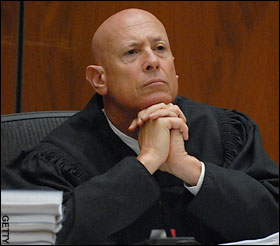
UPDATE 01/24/19: Add label Pierre Romain. Sprocket.
UPDATE 03/03/13: Correction. The previous version of this story indicated defense attorney Aron Laub was late for the scheduled hearing. He was not late. The hearing was scheduled for 9:30 am. Sprocket.
February 22nd, 2013
It’s 8:12 am Friday morning and I’m at the downtown Criminal Justice Center. It’s taken me a while to get back here. I finally recovered from my upper respiratory infection and felt well enough to attend a hearing. I probably could have come to court a few weeks earlier, but I didn’t want to risk the possibility of a spontaneous coughing fit while the judge is on the bench. In the lobby waiting to get through security, I passed defense attorney Donald Re, who is defending German national Gerhard Becker on involuntary manslaughter charges in the death of firefighter Glenn Allen. Re was intently perusing his cell phone when he passed so I didn’t try to say hello. I still have my notes to write up on nine days of preliminary hearing testimony in the Becker case.
Up on the 9th floor, I'm waiting for Department 107 to open, Judge George G. Lomeli’s court to catch up on the latest in the Cameron Brown retrial case. After January 1st, Judge Lomeli took over Judge Michael Pastor’s courtroom and calendar. I believe that Judge Pastor’s clerk, Mrs. Benson and one of his court reporters, Mavis, moved with Judge Pastor to his new assignment in Department 51.
Patty Brown, the defendant’s wife arrives on the 9th floor. Patty is dressed a bit nicer today. She’s wearing gray slacks and a longish, unstructured gray jacket and a hot pink blouse. Instead of the gold shoes I last saw her in, she’s wearing what appear to be a sporty update of a black pair of Mary Jane's. I note the gray rubber soles come up around the edges much like a sport shoe.
There’s quite a bit of bustle happening down at the other end of the hallway around Dept. 109, Judge Kathleen Kennedy’s courtroom. The Bell City Counsel corruption scandal is in its last day of closing arguments and there are quite a few attorneys huddled in groups as well as the media gathering around. I’m tempted to see if there is an available seat once the Brown hearing is over.
Although there are a few attorneys at this end of the hallway, it is very quiet in comparison. Two attorneys, a man and a woman are having a nice chat directly across the hall from me. A tall slender black attorney arrives and stands near my bench. He jokingly calls across the hall to one of them, asking, “What family are you wrecking this week?” The woman pauses a moment before she smiles and responds with, “I’m helping a family out.”
8:29 am. Brown’s defense attorney Aron Laub and DDA Craig Hum have not arrived yet. Two minutes later, a familiar faced deputy that was in Judge Larry Fidler’s court during the first Spector trial, comes out of Dept. 107 and unlocks the door. Instead of going in, I decide to wait in the hallway until counsel arrive. Because I waited, I had a wonderful morning visiting with people I hadn’t seen in months.
The blind interpreter who uses a seeing eye dog (that I've seen around the courthouse for several years now) slowly walks down to this end of the hallway. She tries the door to Dept. 105 but it’s still locked.
I direct my gaze back to watching the bustle of activity at the other end of the hallway. In the center of the hall, a slender woman has her back to me but I instantly know it’s the beautiful Miriam Hernandez with local ABC 7. I take a few minutes to head down to say hello to Miriam.
Back on my bench seat, I see another familiar face heading my way. DDA Beth Silverman (who has made a name for herself successfully prosecuting serial killers and is currently on the Grim Sleeper case) arrives and greets the Asian family across the hall from me. One family member asks Beth, “...What do you think?” As they all head into Department 106, Silverman replies, “I think they are going to drag this out until the judge says no more.”
The next person I see walking towards me brings a big smile to my face. It’s Cold Case Detective (and die hard baseball fan) Rick Jackson, who introduces me to his companion, Detective Liz Estupinian, also with the Cold Case Unit. I ask Rick what case they’re here for. “Pierre Romain,” he replies, and then adds “Something about a plea deal.” I've known about this case for sometime via my friend Matthew McGough. Last I heard it was stalled. Romain was arrested back in December 2003, and I believe it’s the oldest case on Judge Larry Fidler’s calendar. I don’t know if Silverman has anything to do with Rick’s case but I let him know she just went inside 106.
DDA John Lewin of Major Crimes arrives and greets a young man, ‘Brian,’ seated across the hall from me and chomping on a Granny Smith apple. I make a guess that Brian is clerking for Lewin. I’ve never met Lewin, but I’ve heard many good things about him. I saw him take over the Lois Goodman case before charges were dropped against her. (Lewin is well known for successfully tackling difficult cold cases, and a recent case of his was featured on NBC Dateline this past Friday night.) Jackson and Lewin move away to chat privately before they head into Fidler’s court.
By this time I’m wondering when DDA Craig Hum is going to arrive for Brown because I’d ditch plans for the Bell closings so I could sit in on Pierre Romain taking a plea and possibly surrendering today. I keep looking towards the security checkpoint for Hum or Brown’s defense attorney. I then see the court’s Public Information Officer, Pat Kelly taking a stroll from the other end of the hallway. At first I think she’s headed for the ladies room but she comes over to say hello.
Pat asks me why I’m not down at the other end of the hallway on the Bell case that she’s been assigned to cover. I tell her I’m waiting for a pretrial hearing in the Cameron Brown case. Pat tells me she never sat in on any of the testimony, but she was assigned to assist in the jury site visit out at Inspiration Point. Pat heads back to the Bell closing arguments while Lewin and Jackson head into Dept. 106. I overhear Lewin ask Jackson, “What’s Bethy got in here?” Rick replies, “It’s a five-year-old case.”
Moments later Lewin bolts back out of Dept. 106 with Jackson struggling to keep up. Jackson, whose wit I’ve always appreciated, says to me as he passes, “He makes me walk ten feet behind him.”
It’s 9:11 am, and I see the Associated Press reporter clearing security and making their way down to the Bell case.
9:22 am Aron Laub finally arrives and stops to speak to Brown’s wife, Patty. They both then head into Dept. 107 and I follow them a few moments later, taking a seat in the second row.
The courtroom looks quite different. Judge Lomeli has hung several paintings or reproduction paintings on the walls of his court. Behind his bench are portraits of George Washington and Abraham Lincoln. Along the wall above the jury box are what appear to be several Revolutionary War themed paintings in gilded frames. There’s a second portrait of George Washington on the back wall. Thankfully, the blue seat and back cushions are still on the hard wood benches.
There’s a male clerk at what used to be Mrs. Benson’s desk. Laub sits at the defense table and I notice a huge 'scales of justice' on the narrow counter between the bench and the clerk’s desk. The scales almost dominate that area of the room. They look old, most likely bronzed, and appear to be at least two feet tall from where I’m sitting.
DDA Hum is not here but DDA Deborah Brazil from Major Crimes is at the prosecution table sitting in for him. I’ve seen this many times when a DDA can’t make it to a hearing when the only issue being settled is the next appearance date. I’m delighted to see the lovely Brazil, who prosecuted Conrad Murray with former DDA (now Judge) David Walgren. They both received the 2012 CLAY award for their work on the case. I didn’t attend the trial, but I did get to see Brazil’s precise and methodical style when I wrote about Murray’s preliminary hearing from the media overflow room.
Judge Lomeli is not on the bench yet. Laub and Brazil go over the next available scheduling. Laub asks Brazil if she had spoken to Craig, and Brazil replies that she received an email from him, outlining the days Hum would be available to return in March. I believe one of them mentions that this case is tentatively scheduled for late August. Laub tells Brazil they are here to discuss limiting a subpoena for the LA County Sheriff’s, however a new event occurred at the jail and he’s going to ask the judge to sign an order for the Sheriff's to preserve camera and film evidence.
A robust man is sitting at the prosecution table with Brazil and she turns to ask him, “How long have you been a county counselor?” I miss his answer. (Later, I find out this is Anthony A. Peck, Legal Advisor for the LA County Sheriff.)
A pleasant friendly banter begins among the counsel and clerk in the well and I’m not paying much attention at first. I didn’t really take any notes on the discussion and what I remember is not totally clear in my mind. I can’t say that what I recall of the conversation is completely accurate or in the correct chronological order.
Brazil and Laub discuss the dates that Hum had outlined he could come back. The clerk mentions something to the effect that he doesn’t think the date they offer will work because they are starting the Christian Gerhartsreiter case in a couple of weeks, starting on March 11th.
While we wait for Judge Lomeli to take the bench, a discussion begins about all the paintings on the wall and that no women are depicted in any of them. Someone jokingly says, “There weren’t any back then.” For me, a surreal moment occurs when someone suggests there should be a painting of Betsy Ross, sewing a flag. I’m drawn into the conversation when Brazil asks and Patty and myself what we think about the artwork subjects and their placement. I remember telling the room that my name is Betsy Ross, and adding something to the effect that it’s not historical fact that Betsy Ross made the first United States flag, but a rumor, or legend perpetrated by Ross’s descendants.
It’s my memory that Brazil then says something to the effect that she thought that’s who I was and that she’s read T&T. She may have told me that she enjoys reading the observations I write about. I’m now completely in my second surreal moment of the day because a talented prosecutor in a case I followed is asking me several questions about what drew me to writing about trials, how did I get started, what other cases am I following and what else I would I like to do.
One of the things I mention is eventually studying the California Evidence Code, so I can better understand when counsel cite them in their motions or judges use them in their rulings. Brazil and Peck both tell me that’s not necessary. They state there are only about twenty codes they use on a regular basis. Smiling, Peck hands me a 2010 copy of the California Evidence Code. I briefly look through it before handing it back.
I’m not positive, but I think it’s Brazil who mentions that this is a fascinating case, and I agree. I’m sure she didn’t know when she brought that up that the other woman in the gallery was the defendant’s wife.
Patty Brown takes this opportunity to tell Brazil her thoughts on the great miscarriage of justice that is happening in this case. Brazil patiently listens as Patty claims that she knows that “they” changed the topography of the cliff and that the autopsy report was changed after the fact. Patty talks passionately about how she has researched and tracked the statistics of cliff side deaths along the Southern California coastline. Patty states statistically, depending on the jurisdiction of which law enforcement agency investigates a cliff side death, that alone will determine whether it’s charged as a homicide, suicide or accident.
Patty then talks about another cliff side death that I believe she states, “parallel’s this case exactly.” She mentions that several times. Patty tells Brazil she even attended the trail of the individual charged. Patty goes on about this for a bit until I finally have to ask Patty how old was the victim in the case she attended. “Eighteen or nineteen,” Patty responds. After more of this Brazil finally asks Patty if she’s related to the defendant and Patty tells her she’s Brown’s wife.
When Brown is finally brought out I could swear I observed a momentary expression of surprise on Brazil’s face, and I’m guessing it was from Brown’s ZZ Top appearance.
At 10:12 am the court reporter comes out and sets up at her desk. A few moments later Judge Lomeli takes the bench and I see him for the first time. The parties appearance are put on the record.
I believe it’s Laub who starts out by saying they are here today because the subpoena for materials issue was put over from the last hearing. I believe Laub agrees that the initial subpoena was over-broad. Laub continues, “That’s become secondary to another issue. On January 21st, Brown accused another inmate of throwing bodily fluids on him. The Sheriff claims to have investigated and looked at the camera recordings. They came to the conclusion that Brown made a false accusation. Consequently, he received twenty days of no privileges. They seized all his belongings and legal papers.”
Laub then says something to the effect that this may be “...building towards a due process violation” by the Sheriffs. Maybe some of the Sheriff’s staff believe Brown is an easy target. Laub is asking the court to order that four days of video material be preserved so that Laub can review it. He also is to go over with the Sheriff’s counsel regarding the reworking of the subpoena.
Judge Lomeli states he doesn’t know about the Sheriff’s procedures (regarding the camera taping). “Do they tape over?” the Judge asks. As Judge Lomeli asks this question, I see the Sheriff’s counsel shaking his head from side to side. Judge Lomeli then asks that this be checked to see if that’s not the case, and see if the tapes are still in existence. He doesn’t want to sign an order for something that no longer exists.
Laub tells the court he is asking for tapes covering the day before the incident, the day of the incident and two days after the incident be preserved.
Judge Lomeli then asks the parties where are they on the court clock, because before today they were at zero of 90. The prosecution and the defense tell Lomeli they would like to return the week of March 18th. Judge Lomeli replies, “That’s a bad week. The Rockefeller case is starting that week.” The parties then agree on March 21st to return at 8:30 am. There is a pleasant exchange at the bench between Laub and Judge Lomeli about today's scheduled time. Laub thought he was late, but he wasn't. The hearing today was set for 9:30 am. Judge Lomeli addresses Laub about the 21st, telling him he must be here at 8:30 am because he will be in trial.
Judge Lomeli states the court clock on the case as of today is twenty-six of 90. The goal for the case is to get started at the end of August. Right before Judge Lomeli leaves the bench, Laub asks for a medical order for Brown, which he approves. And that’s it. I wait for the Sheriff’s counsel to leave so I can make sure I have his name correct and then head over to Dept. 106 to see if the Romain hearing has started yet.
Pierre Romain
When I enter 106, I have my third surreal moment of the day. I’m not positive, but I think this is the first time I’ve been back in Judge Fidler’s courtroom since Spector was sentenced on May 29th, 2009. Wendy is still Judge Fidler’s clerk. Although a little thinner in the face, Fidler looks almost exactly the same as when I last saw him, a possible stand-in for one of my favorite actors, Bruce Willis.
Beth Silverman’s case must have already been heard since she and the Asian family are long gone, yet there is still quite a bit of bustle going on in the well. Several different groups of attorney’s are all in conversation at once. I hear that there is a search warrant issue to be heard and a defendant is brought out in a blue jumpsuit. A black couple with a very young child enter and sit in the back row by the door. Judge Fidler is at sidebar with DDA Lewin and the tall slender black man I observed in the hallway earlier, who asked about what family was being wrecked. I’m guessing he is Romain’s counsel. I believe I heard Judge Fidler say, “The never ending case.” Fidler then asks, “So where are we at?”
10:25 am. Judge Fidler is still at sidebar and the several other discussions are still going on. There’s so much conversation going on at once, it drowns everything out and I can’t follow a single one. In the gallery, there is a large group of very young, fresh looking law students wearing dark suits and white shirts. I see some with blue badges and my best guess is that they are clerking for the DA’s office.
The sidebar is now over and Fidler takes the bench. The other matter is put over to a new date and the Romain cases is called. The parties identify themselves for the record. Romain’s attorney, Mr. Fletcher is not here and the slender black gentleman I think is standing in for him. Judge Fidler says something to the effect that because Mr. Fletcher isn’t here, he’s not prepared to rule on the matter.
Judge Fidler mentions this is his oldest case, then suddenly I’m hearing him say, “995 Motion ... If you are hoping 995 will rescue (you?) ... I wouldn’t put any hope in that. ... The DA made an offer to you....” The defendant is told that if he goes forward with this 995 motion, that offer is gone, it goes away. It won’t be offered again.
I believe it’s Judge Fidler who states he wants Mr. Fletcher here and he’s informed that he is in route. Fidler states he will call the case when Fletcher gets here. Detectives Jackson and Estupinian exit 106 and I follow them out.
DDA Lewin comes out with the group of law clerks that are now gathered around him in rapt attention, waiting for him to speak. It looked to me like Lewin was about ready to blow a gasket. I believe he talks about going through a great deal of trouble to get his senior management to sign off on this plea agreement. Now the defendant wants to try a last minute Hail Mary (the 995 motion). I’m betting Lewin is beside himself with frustration.
While I’m observing Lewin explaining things to the law clerks, I have my fourth surreal moment of the day. Brown’s defense attorney Aron Laub sits down beside me on the bench and wants to ask me my opinions about his client’s case since I experienced the second trial and he didn’t. I tell Laub this is a totally different experience for me in comparison to how Phil Spector’s defense attorneys treated me. Laub and I chat for a bit until I see the detectives and Lewin head back into Dept. 106.
Back inside Dept. 106, I catch the tail end of a bawdy story Lewin is telling about Detective Jackson. Rick makes a point to tell me I can’t repeat it. Someone in the well asks Lewin about all the law clerks in the gallery, and Lewin says that they are all working for him. He adds something to the effect that he’s had law clerks for many years now.
Another case is called before Judge Fidler but there’s no counsel with the defendant who is in jail blues. It’s clear the accused has gone ‘pro per’ and is representing himself like accused serial killer, Michael Gargiulo.
Finally the Romain matter is called. It appears that at this late date, Romain decides to pinch hit, and replace his current counsel, Mr. Fletcher with Winston McKesson. Romain wants McKesson to file a 995 motion for him because Mr. Fletcher wouldn’t file one. It appears Judge Fidler’s earlier advice to the defendant about a 995 motion fell on deaf ears. I’m not positive, but the gist of what I think I’m hearing from Mr. Fletcher is, part of the problem has to do with another matter where Romain’s assets may have been frozen and Mr. Fletcher hasn’t been paid. I honestly don’t know if I have that right or not.
Defense counsel Fletcher asks Judge Fidler to be relieved, citing contentious, personal insults to him by the defendant. He can’t represent him anymore and he can’t see a better outcome. Judge Fidler has no objection to the change in counsel, but he advises the new counsel that he won’t wait another year to take this case to trial. He asks how long he needs to prepare.
I believe Lewin states he can be ready for the 995 motion by May. McKesson states he needs to appoint experts. I believe Lewin states something to the effect that he’s been waiting to do (another?) trial for more than two years, and he has two issues. He’s starting a long trial in October with over two hundred witnesses (I believe that’s what he said; two hundred!) and he goes on vacation for the entire month of August.
Judge Fidler replies, “I understand.” He recommends putting a date of zero of 60 for the 995 motion. Lewin counters, “I’d like to make it zero of 120 on the 995.” Lewin then goes on the record about how much time and effort he put into trying to arrange this plea deal, to now have it all fall apart at the last moment. He tells the court that he’s spoken with Mr. Romain. He’s never put as much work as he has into this issue of going to his supervisors and upper management to make this offer and get it approved. Lewis tells the court, “I've told him repeatedly that if the 995 goes forward, (the deal is off the table) ... (it’s) highly unlikely to have a happy ending. ... this client is unhappy that Mr. Fletcher didn’t run a 995. ... (He’s facing) 25 to life on felony murder. ... Mr. Romain continues to (?) the idea that he really wants his due process. ... When we leave the courtroom today that offer is gone.”
I believe Lewin goes on to say that Mr. McKesson doesn’t know the case. Mr. Fletcher then addresses the court as to the reason they got here, and goes over the merits of the case. Fletcher feels there is no basis to file a 995 motion. I believe he states that he has a bullet with DNA from Cellmark (labs). Why waste (the defendant's) money and time and the (integrity?) of the court. “I’ve had conversation (after?) conversation with Mr. Romain,” Fletcher continues. “There are so many issues at trial.”
Judge Fidler asks for a date in May for the parties to return and then he addresses Romain, “Mr. Romain, you understand no more deal?” Romain answers, “Yes.”
After some back and forth of trying to arrange the schedules of two detectives and both counsel, the date May 6th at 9 am is agreed upon with the case calendar set at zero of 120. Mr. Fletcher is released and ordered to turn over the file to Mr. Kesson, who is appointed as Romain's new defense counsel.
Later, I find out that the plea agreement that DDA Lewin had worked so hard for was for Romain to plead to manslaughter. Since the crime occurred in 1987, you have a similar situation in the sentencing of Stephanie Lazarus. My understanding is, the longest sentence Romain would have received was eight years. With the 1987 rules in effect for time served, he would have been out in four years. In my opinion, this would have been an amazing gift to the defendant from the DA’s office. Now, Romain is facing the strong possibility of 25 years to life if convicted of first degree murder. Sometimes, you just can’t make this stuff up.
LA Times, December 2003 Pierre Romain Story
Sunday, February 24, 2013


Tuesday, February 19, 2013
Alan Jackson Says Goodbye to the DA's Office

UPDATE Jan 21st, 2013 Alan Jackson will be on Headline News (HLN) at 6PM PST with Dr Drew discussing the Jodi Arias case.
On February 6th, 2013, the Los Angeles Times reported:
Alan Jackson, a veteran Los Angeles County prosecutor whose bid to become district attorney ended in defeat in November, is leaving the district attorney's office to join a private, downtown firm that practices civil law.I was quite sad to read the news.
Jackson, 47, said his last day in the office he sought to lead will be Feb. 15. He will pursue a career as a civil litigator with Palmer, Lombardi and Donohue, whose three partners were political supporters of his election campaign.
I'll never forget the first time I spoke to Jackson. It was in the evening, August 16th, 2007, months into the first Phil Spector murder trial. Spector was on trial for the murder of Lana Clarkson and it was being televised on CourtTV.

That day and the day before had been two exceptionally stressful days for me in Judge Fidler's courtroom. When I left the trial that day, I swore I wouldn't go back. I was in my kitchen and I got a call from Dominick Dunne, who tells me he's at the Dodger game in a private box. He's with the entire prosecution team on the Spector case and having the time of his life. Dominick tells me the topic everyone is talking about at the game is the admonishment Judge Fidler gave me on the record. (I was accused of being the individual who spoke so loud in court that the jury heard me.) Dominick then tells me he has someone who wants to speak to me. The next voice I hear is DDA Alan Jackson.
I don't remember everything he said in that first conversation, but I do remember him telling me that he would talk to the judge. That this judge was a fair judge and he would like for me to come back to court on the next scheduled court day, which was a Tuesday. Because Jackson took it upon himself to go to the judge, I got an apology from Judge Fidler on the record. Because of Jackson, I was vindicated. That event was the catalyst that eventually developed into a friendship with Alan.
After the debacle of the first Spector trial, Jackson and I stayed in touch. T&T got it's start during the first Spector trial and, I made a point to try to cover cases that Jackson was assigned. Jackson was a brilliant prosecutor, a charismatic orator, and I wanted to follow his career. I wanted to experience first hand, his skills in the courtroom and write about the cases he prosecuted.
When Kazuyoshi Miura was arrested in Saipan, I started to go to the hearings.

Robbery Homicide Detective Rick Jackson, left,
Kazuyoshi Miura, right
Kazuyoshi Miura was convicted of the 1981 shooting death of his wife, Kazumi, on a downtown Los Angeles street in his native country, Japan. Ten years later, a higher court overturned the verdict and he was released. In February 2008 Miura traveled to Saipan, a US territory, where was arrested on an outstanding 1988 warrant. He was held in Saipan while attorneys in Los Angeles argued whether he could be brought back to the US and tried for murder, again.
It was a complicated legal issue. Miura's defense attorney, Mark Geragos, argued that bringing him back to the US and prosecuting him again would be double jeopardy. The court transcripts from Japan had to be obtained and translated. A expert witness in the Japanese language testified to the accuracy of the translation and the meaning of specific words. It was difficult to follow each side's arguments as to which aspect of the Penal Code should apply.
Because of the arguments presented by Jackson and his co-counsels DDA Ricardo Ocampo (now Judge Ocampo) and DDA Phyllis Asayama, Judge Van Sicklen ruled: “Although the murder charge is barred by double jeopardy, the State may proceed on the charge of conspiracy to commit murder because there is no evidence that Miura was previously acquitted or convicted of the same offense in Japan." Unfortunately, the case ended when Miura committed suicide within 24 hours of touching down on US soil.
When Spector's retrial finally came around in November 2008, I knew I would dedicate myself to attending every single day of the case. I wasn't going to let Spector or his trial bride try to eject me from the courtroom again. There were no cameras this time and Jackson had a new co-counsel, DDA Truc Do (now with Munger Tolles & Olson). It was during the retrial that Jackson opened up more, and insisted I keep him informed of any intimidation tactics the Spector's or their supporters threw my way.
Alan's strategy for the second trial was tighter, more focused, presenting fewer witnesses than the first trial. Alan and Truc Do's opponent this time was not a large defense team, but a single counsel, Doron Weinberg, a crafty and difficult adversary. From the very start, Jackson and Weinberg had difficulty getting along. To me, it appeared that Weinberg used every delay tactic he could not to turn over discovery. Even Judge Fidler commented outside the presence of the jury that it was "evident" Jackson and Weinberg couldn't stand each other. Weinberg was able to convince Judge Fidler to let him present an expert on suicide and an expert on memory. Despite these obstacles, Jackson's cross examination of many of the defense witnesses was a pleasure to watch. The most memorable were doctors Werner Spitz and Vincent DiMaio. Spitz lost his temper more than once on the stand and could not answer the most basic questions about his billing practices. I remember that defense expert Dr. DiMaio complimented Jackson on an excellent cross examination when he stepped off the stand.
Alan was the first person I asked for advice when a Spector fan posted my personal information online and he willingly gave it. No matter what the question was, Alan always found the time to respond. During the second trial there were many times that people in the gallery would ask the prosecution team questions before court started. At one point, I asked him if he would ever consider going into private practice. At the time he responded in a very strong tone, "Never!" Jackson's message was clear. He was a career prosecutor. Prosecuting criminals was his life's work. But things happen in our lives that we can't always foresee. As everyone knows, Spector was convicted of second degree murder on April 13th, 2009.

Spector booking photo, post conviction
Over the next several years, I was fortunate to attend many court hearings and one more trial where Alan was involved in the prosecution: the Lily Burke, preliminary hearing, the James Fayed, trial and pretrial hearings for Kelly Soo Park and Alberd Tersargyan.
No matter the case, attending a trial or a short pretrial hearing where Alan was the prosecutor was always time well spent.

James Fayed, sentenced to death
I'll never forget during the James Fayed case, when Alan brought some of the seized gold bars and gold coins into court. He passed a $50,000 gold bar to Judge Kennedy and the jurors, so they could feel the weight of it. After that day in court, I asked him what it was like. He was astounded at the experience of having over a million dollars in bullion sitting in a box at his desk that morning (with a FBI agent in tow, guarding the bullion), as well as holding a single gold bar, the cost of a brand new Lexus, in his hand.
In May 2010, Alan received his second prosecutor of the year award. By this time he had already been promoted to Assistant Head Deputy of Major Crimes. Even though my trial coverage took a back seat to my real life responsibilities, I tried to report on the various projects Alan was involved in and keep in touch with him by email.
When Alan announced in December 2010 that he was making a run for the District Attorney's Office, I immediately signed up on his campaign web site. I didn't think twice about it. It didn't matter than we were members of opposing political parties because I knew Alan personally. I felt he had the integrity and skills to lead the DA's office.
Even though the DA's office is non-partisan, politics is still a major factor in this race. I knew Alan would have a tough road to climb in a mostly democratic county. Even though I had never written about this type of subject, in support of Alan, I attended many of the debates for district attorney and blogged about them.
When Alan was defeated on November 6th, I was hoping that things would work out at the DA's office. Sadly, that was not to be. Back in May 2011 during the Fayed trial, I asked Alan, "What are your plans if you don't win?" At that time, he told me he didn't have a "Plan B" and I was very worried for him. Fortunately, he did eventually get a plan in place. Alan joined the civil litigation firm of Palmer, Lombardi & Donohue.
There's no question that Alan is a brilliant trial strategist, highly respected by his peers. The clients that chose him, will get a tirelessly dedicated attorney that will fight the hardest for them. Even though Alan has moved into civil litigation, I hope to continue following his career by dropping in on the cases he takes on. Best of luck to you Alan. I hope to see you inside a courtroom again, soon.
Vanity Fair, Domick Dunne 'Legend With A Bullet'
About Alan Jackson, (From Vote Alan Jackson website)
LA Times, DA's Rival Has A New Post
LA Times Opinion, Lacey's Definition of Lateral
Note:
Phil Spector convicted of the murder of Lana Clarkson
James Fayed convicted of the murder for hire of his wife, Pamela
Kelly Soo Park is charged with the first degree murder of Juliana Redding
Alberd Tersargyan is charged with four murders
Kazuyoshi Miura, convicted in Japan of murdering his wife, Kazumi. Verdict overturned.
Thursday, February 14, 2013
Vanessa Coleman Gets 35-Year Sentence
GUEST ENTRY FROM DAVE IN TENNESSEE!
I apologize for the lateness of this post. David did write it two weeks ago, and I got swamped with real life responsibilities to Mr. Sprocket. I hope to get back to court and reporting on cases soon. Sprocket.
Vanessa Coleman was sentenced on February 1st, 2013, to 35 years in prison after being convicted for a second time of the facilitation of the rape and murder of Channon Christian in January 2007.
After her first trial in 2010, Coleman received a 53-year sentence from former Judge Richard Baumgartner, who has been convicted in federal court of drug offenses while on the bench. Baumgartner's infractions gave Coleman a second trial last November in which she was convicted on 13 of 17 counts, less than the first time.
This resulted in a lesser sentence. The prosecution asked for 49 years, the defense for 13. Judge Jon Kerry Blackwood handed down a 35-year sentence.
Since Coleman has been incarcerated for six years, she will come up for parole in around five years.
Judge Blackwood called the Christian-Newsom murders "the most horrible" murder case he had ever seen. He sentenced Coleman to the maximum terms of 25 years on facilitation of murder, six years on facilitation of kidnapping, and four years for facilitation of rape.
Knoxville News Sentinel reporter Jamie Satterfield wrote: "Although Blackwood said Coleman's 'youth' and lack of criminal history supported a lesser sentence, he opined those mitigating factors were outweighed by the fact that Coleman did nothing to stop the atrocities Christian suffered."
"The psychological torture of this unfortunate victim was immense," Judge Blackwood said.
The ringleader of the torture-murders of Channon Christian, Lemaricus Davidson, and his half-brother, Letalvis Cobbins, were denied new trials by Judge Walter Kurtz. The other defendant, George Thomas, will receive a second trial. A date for Thomas' trial has not been set.
The above link has a video with an interview with Channon Christian's parents, Gary and Deena.
I apologize for the lateness of this post. David did write it two weeks ago, and I got swamped with real life responsibilities to Mr. Sprocket. I hope to get back to court and reporting on cases soon. Sprocket.
Vanessa Coleman was sentenced on February 1st, 2013, to 35 years in prison after being convicted for a second time of the facilitation of the rape and murder of Channon Christian in January 2007.
After her first trial in 2010, Coleman received a 53-year sentence from former Judge Richard Baumgartner, who has been convicted in federal court of drug offenses while on the bench. Baumgartner's infractions gave Coleman a second trial last November in which she was convicted on 13 of 17 counts, less than the first time.
This resulted in a lesser sentence. The prosecution asked for 49 years, the defense for 13. Judge Jon Kerry Blackwood handed down a 35-year sentence.
Since Coleman has been incarcerated for six years, she will come up for parole in around five years.
Judge Blackwood called the Christian-Newsom murders "the most horrible" murder case he had ever seen. He sentenced Coleman to the maximum terms of 25 years on facilitation of murder, six years on facilitation of kidnapping, and four years for facilitation of rape.
Knoxville News Sentinel reporter Jamie Satterfield wrote: "Although Blackwood said Coleman's 'youth' and lack of criminal history supported a lesser sentence, he opined those mitigating factors were outweighed by the fact that Coleman did nothing to stop the atrocities Christian suffered."
"The psychological torture of this unfortunate victim was immense," Judge Blackwood said.
The ringleader of the torture-murders of Channon Christian, Lemaricus Davidson, and his half-brother, Letalvis Cobbins, were denied new trials by Judge Walter Kurtz. The other defendant, George Thomas, will receive a second trial. A date for Thomas' trial has not been set.
The above link has a video with an interview with Channon Christian's parents, Gary and Deena.
Subscribe to:
Posts (Atom)


 Posts
Posts